Preventing HVAC Coordination Rework Through Pin Protection
Introduction
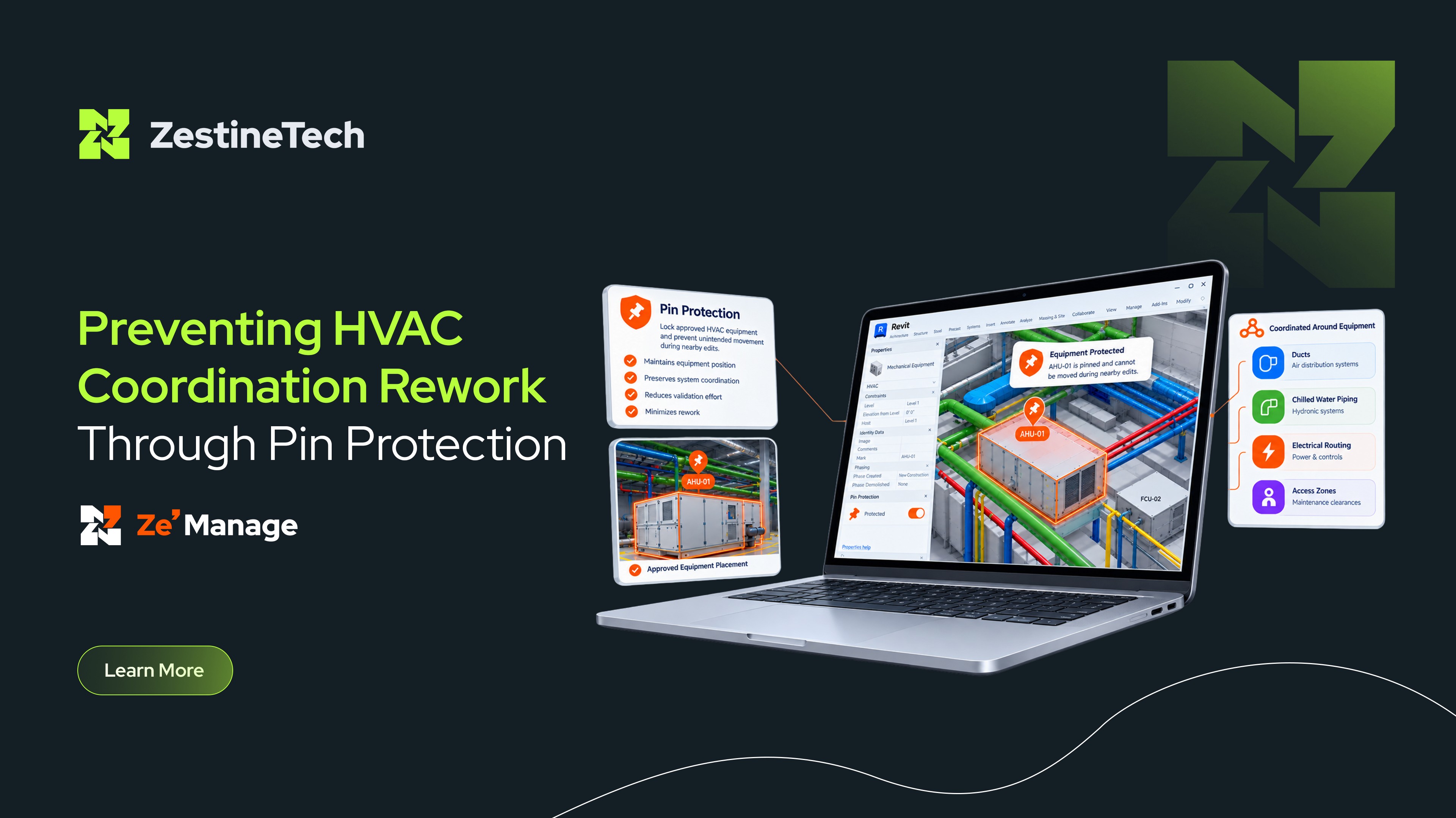
In HVAC BIM workflows, approved equipment placement is critical because AHUs and FCUs define mechanical room layouts, service zones, connected systems, and maintenance clearances. Once their locations are finalized, surrounding ducts, chilled water piping, electrical routing, and access zones are coordinated around them.
Within collaborative Autodesk Revit environments, unintended equipment movement during nearby edits can disrupt these relationships, increase validation effort, and create avoidable rework. Pin Protection provides controlled protection for approved HVAC equipment, helping teams maintain stable positioning and reliable coordination throughout the project lifecycle.
In this Blog
Key Takeaways
Why HVAC Equipment Movement Creates Coordination Risk?
How Pin Protection Secures HVAC Equipment?
Benefits & Business Impact
Best Practices for HVAC Equipment Protection
Conclusion
01. Key Takeaways
Protected AHU and FCU positioning
Reduced unintended equipment movement
Stable mechanical room coordination
Reduced HVAC rework and validation
Controlled equipment modification
02. Why HVAC Equipment Movement Creates Coordination Risk?
During HVAC development for a mixed-use commercial project, a mechanical room underwent minor layout refinement to accommodate updated architectural service access. While repositioning nearby duct supports, an approved AHU was unintentionally moved from its finalized location.
Although the movement was small, it affected connected duct entry points, chilled water pipe alignment, and maintenance clearance. The issue was identified only during later clearance validation and coordinated review, requiring additional alignment checks, rerouting, and coordination updates.
Common challenges included:
Approved AHU and FCU locations vulnerable to accidental movement
Surrounding service layouts affected by equipment changes
Difficulty monitoring equipment-level changes across users
Access clearance and installation space affected
Repeated mechanical room revalidation
Additional manual coordination checks
Because HVAC equipment connects multiple services simultaneously, even a small positional change can create downstream coordination issues.
03. How Pin Protection Secures HVAC Equipment?
Pin Protection provides controlled protection for approved HVAC equipment within shared Autodesk Revit workflows. The solution protects equipment locations and coordination-sensitive areas while allowing authorized modifications through a controlled workflow.
Protected components can include:
AHU placement locations
FCU positioning
Equipment-connected routing points
Mechanical room coordination layouts
Clearance-sensitive equipment zones
When protected equipment requires modification:
Submit Modification Request
The user requests access to modify the protected equipment.Administrative Approval
The requested modification is reviewed and approved by the administrator.OTP Verification
OTP verification provides temporary access for the authorized modification.
This creates a controlled and traceable process while helping maintain approved HVAC layouts.
04. Benefits & Business Impact
Pin Protection helps HVAC teams achieve:
Reduced Unintended Equipment Movement — protects approved AHU and FCU locations.
Improved Mechanical Layout Stability — maintains finalized equipment positioning.
Reduced Rerouting Effort — helps preserve connected duct and pipe alignment.
Faster Coordination Validation — reduces repeated equipment alignment checks.
Improved Maintenance Access Compliance — helps maintain clearance-sensitive zones.
Lower Rework Effort — minimizes coordination disruption caused by equipment movement.
05. Best Practices for HVAC Equipment Protection
Protect approved AHU and FCU locations
Secure clearance-sensitive equipment zones
Control modifications through authorization
Verify equipment alignment during coordination reviews
Maintain traceability for protected modifications
Include equipment protection in BIM governance workflows
06. Conclusion
In HVAC BIM workflows, AHU and FCU placement forms a critical reference for connected ducts, piping, electrical routing, and maintenance access. Unintended movement can therefore create downstream coordination issues, increase validation effort, and trigger rework.
By implementing Pin Protection, HVAC teams can protect approved equipment placement, control authorized modifications, maintain stable mechanical layouts, and support more reliable project delivery throughout the BIM lifecycle.
Author:
Sivaranjani S
Associate Product Developer
Responsible for BIM workflow analysis, Revit automation, tool development, testing, and product documentation, with a focus on reducing repetitive tasks, improving modelling efficiency, and delivering practical automation solutions for BIM workflows.
LinkedIn Profile: Sivaranjani S


